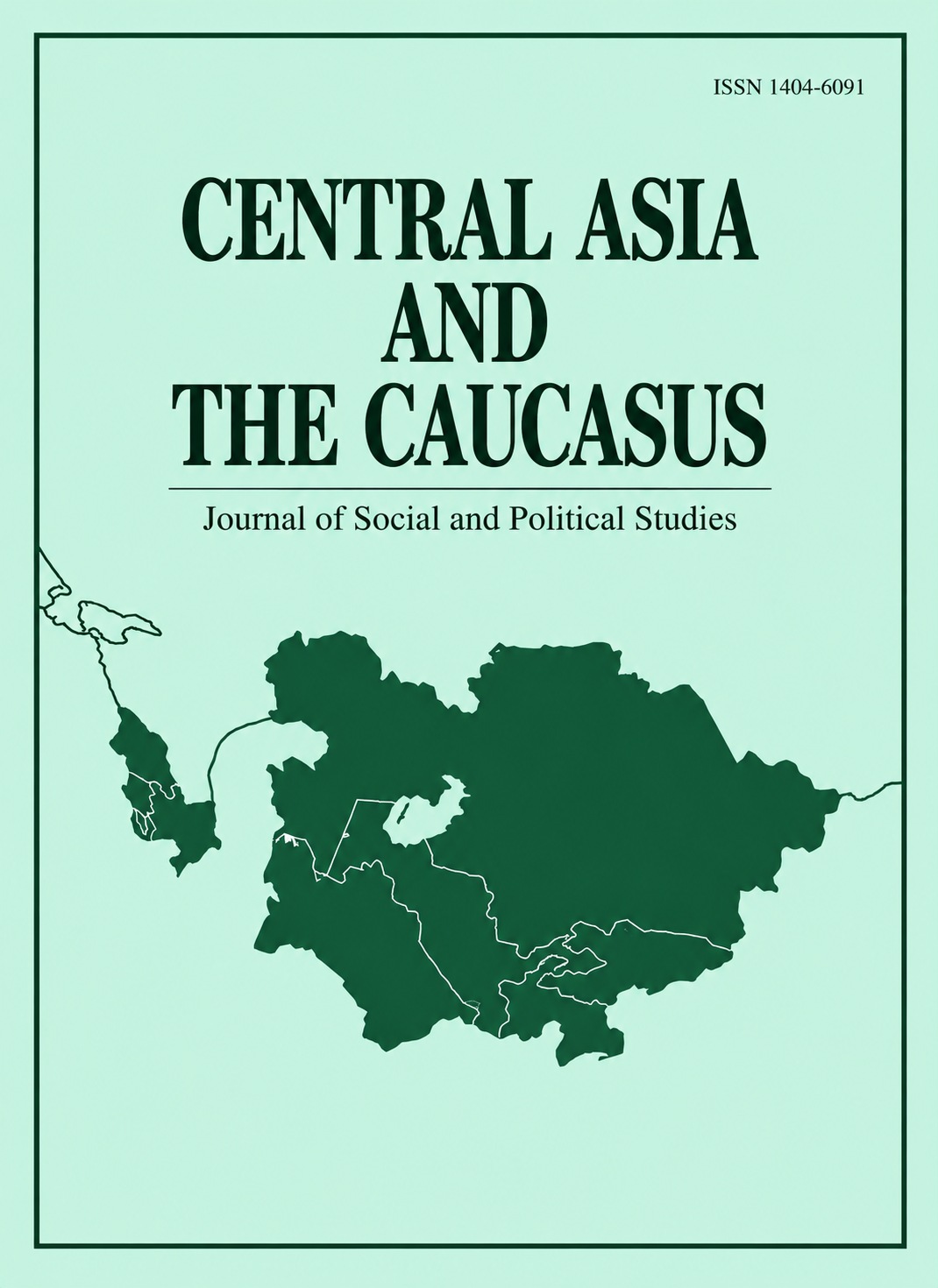
CONTEMPORARY WATER ISSUES IN CENTRAL ASIA: CHALLENGES AND SOLUTIONS
DOI:
https://doi.org/10.61841/a8frgd17Keywords:
Transboundary Cooperation, Food Security, Irrigation Practices, Public Health, Environmental Governance, Climate AdaptationAbstract
Central Asia, situated around the Amu Darya and Syr Darya river basins and bordered by
the Caspian and Aral Seas, is grappling with acute water-related challenges that threaten
ecological balance and socioeconomic stability. The crisis is exemplified by the desiccation
of the Aral Sea due to unsustainable water diversion and escalating pollution in the Caspian
Sea, which endangers biodiversity and coastal livelihoods. Climate change has further
intensified these pressures through accelerated glacial melting in Kyrgyzstan and
Tajikistan, jeopardizing long-term freshwater availability. Growing water scarcity affects
agriculture, food security, public health, and regional relations, exposing a paradox of
resource abundance amid environmental vulnerability. This paper analyzes the
environmental, economic, and social dimensions of Central Asia’s contemporary water
issues, emphasizing governance deficits, inefficient management, and transboundary
tensions. It further evaluates solutions including regional cooperation, modern irrigation
technologies, and integrated water resource management to enhance resilience and
promote sustainable development.
Downloads
References
*ADB (2024). Central Asia Regional Economic Cooperation Program Climate Change Action Plan 2025-2027. Manila: Asian Development Bank. URL: http://dx.doi.org/10.22617/SGP240577-2
Alieva, N. A. (2022). Tajikistan to Protect its Natural Resources and Increase Climate Resilience, with World Bank Support. World Bank Group. Retrieved September 12, 2025, from https://www.worldbank.org/en/news/press-release/2022/02/25/tajikistan-to-protect-its-natural-resources-and-increase-climate-resilience-with-world-bank-support
AllRefer (2016, March). Kazakhstan - Environmental Problems in Kazakhstan. Retrieved January 12, 2025, from Kazakhstani Information Resource: http://reference.allrefer.com/country-guide-study/kazakhstan/kazakhstan17.html
Altan, T. (1995). An Exhausted Environmental Legacy: Environmental Problems in Central Asia Beyond Borders, and Destruction of Natural Resources. Eurasian Studies, 2(1).
Bedford, D. P. (1996). International Water Management in the Aral Sea Basin. Water International, 21(2), 63-69. URL: https://doi.org/10.1080/02508069608686491
Bernauer, T. a. (2012). Climate change and international water conflict in Central Asia. Journal of Peace Research, 49(1), 227-239. doi:10.1177/0022343311425843
Bolch, T. (2007, March). Climate change and glacier retreat in northern Tien Shan (Kazakhstan/Kyrgyzstan) using remote sensing data. Global and Planetary Change, 1-12. URL: https://doi.org/10.1016/j.gloplacha.2006.07.009
Borovsky, V. M. (1980). The Drying Out of the Aral Sea and Its Consequences. Soviet Geography, 21(2), 63-77. URL: https://doi.org/10.1080/00385417.1980.10640323
Braun, N. L. (2009). Assesment of snow, Glacier, and Water Resources in Asia: Selected papers from the workshop in Almaty, Kazakhstan, 2006. Koblenz: UNESCO-IHP and the German IHP/HWRP National Committee. Retrieved August 18, 2025, from https://waterandchange.org/wp-content/uploads/2017/04/Heft8_en.pdf
Buckley, C. (2003). Children at risk: infant and child health in Central Asia. the William Davidson Institute, 1-18. Retrieved January 17, 2025, from https://papers.ssrn.com/sol3/papers.cfm?abstract_id=375601
Carius A., F. M. (2003). Addressing Environmental Risks in Central Asia. Berlin: United Nations Development Programme. Retrieved January 2, 2025, from http://www.cawater-info.net/library/eng/envsec_undp_ca_study.pdf
Casp Info. (2019). Environment - Caspian Sea facts - Caspian Info. Retrieved January 30, 2025, from http://www.caspinfo.net/content/content.asp?menu=0120000_000000
Chen, Y. L. (2017, February 2). Hydrological modeling in glacierized catchments of Central Asia: status and challenges. Hydrology Earth System Sciences, 21, 669-684. doi:10.5194/hess-21-669-2017
*CPC (….). The Vital Resource: Water Management in Central Asia. Policy Brief by the Caspian Policy Center. Retrieved from https://api.caspianpolicy.org/media/uploads/2020/11/The-Vital-Resource-Water-Management-in-Central-Asia-01.pdf
Doede, A. L. (2020, June 27). The Disappearing Lake: A Historical Analysis of Drought and the Salton Sea in the Context of the GeoHealth Framework. Advancing Earth and Space Science, 1-12. doi:10.1029/2020GH000271
Dussaillant, I. e. (2025, May 9). Annual mass change of the world's glaciers from 1976 to 2024 by temporal downscaling of satellite data with in situ observations. Earth System Science Data, 17(5), 1977-2006. URL: https://doi.org/10.5194/essd-17-1977-2025
*EJF (2012). The true costs of cotton: cotton production and water insecurity. London: Environmental Justice Foundation. Retrieved from https://ejfoundation.org/resources/downloads/EJF_Aral_report_cotton_net_ok.pdf
*ERI (2020). UN Population Prospects: Case of Central Asia. Eurasian Research Institute. Retrieved July 10, 2025, from https://www.eurasian-research.org/publication/un-population-prospects-case-of-central-asia/
Eurasianet (2025, Auguest 26). World Bank seems to be having second thoughts about Tajikistan’s Rogun Dam. Retrieved December 13, 2025, from https://eurasianet.org/world-bank-seems-to-be-having-second-thoughts-about-tajikistans-rogun-dam
*Geneva Water Hub (2020). Hydrodiplomacy in Rapid Action: Early Insights from the Sardoba Dam Disaster in Central Asia. Global Observatory for Water and Peace. Retrieved July 27, 2025, from https://www.genevawaterhub.org/sites/default/files/atoms/files/central_asia_sardoba_dam_disaster_rapid_hydrodiplomacy_-_finalsept_2020.pdf
Gleason, G. (2001, February 6). Upstream-Downstream: The Difficulties of Central Asias Water and Energy Swaps. Retrieved August 25, 2025, from https://eurasianet.org/upstream-downstream-the-difficulties-of-central-asias-water-and-energy-swaps
Gleick, P. H. (1993). Water and Conflict: Fresh Water Resources and International Security. International Security, 18(1), 79-112. Retrieved from http://ereserve.library.utah.edu/Annual/POLS/5470/Odencrantz/water.pdf
Gorodetskaya, M. Y. (1978). Alma Ata Conference on the Environmental Impact of a Drop in the Level of the Aral Sea. Soviet Geography, 19(10), 728-736. doi:10.1080/00385417.1978.10640268
Hays, J. (2008). Environmental Issues in Kazakhstan_Fact and Details. Retrieved from factsanddetails.com: http://factsanddetails.com/central-asia/Kazakhstan/sub8_4f/entry-4681.html
*Iceland, C. A. (2018). Issue Brief: Water Security and Conflict. World Resource Institute. Retrieved from https://www.thegpsc.org/sites/gpsc/files/watersecurityconflict.pdf
*IPCC (2001). Climate Change 2001: Impacts, Adaptation, and Vulnerability. UNEP & WMO, Intergovernmental panel on Climate Change. United States of America: Cambridge University of Press. Retrieved from https://www.ipcc.ch/site/assets/uploads/2018/03/WGII_TAR_full_report-2.pdf
Islamov, B. (1998). Aral Sea Catastrophe: Case for National, Regional and International Cooperation. Slavic Research Center. Retrieved January 2, 2025, from http://133.50.171.227/sympo/97summer/islamov.html
ITACAProject (2019), Innovative Training Centre to support a postgraduate 3rd cycle Advanced Course to face Environmental Emergency in Azerbaijan, Co-funded by the Erasmus+ programme of the European Union, pp. 28. Retrieved from https://cdn.website-editor.net/e42d3fcc84ba4f759000fe93c4f1b54b/files/uploaded/Final%2520draft%2520deliverable%2520D.1.2..pdf
Janusz-Pawletta, B. a. (2015). Transboundary Water Management in Central Asia: Legal Framework to Strengthen Interstate Cooperation and Increase Regional Security. Cahiers d’Asie centrale(25), 195-215. Retrieved from http://journals.openedition.org/asiecentrale/3180
Jensen, S. M. (1997, August 2). Environmental pollution and child health in the Aral Sea region in Kazakhstan. The Science of the Total Environment, 206, 187-193. Retrieved February 12, 2025, from https://www.sciencedirect.com/science/article/abs/pii/S0048969797800095
Karesdotter, E. e. (2023). Water-related conflict and cooperation events worldwide: A new dataset on historical and change trends with potential drivers. Science of the Total Environment, 868(161555). doi:http://dx.doi.org/10.1016/j.scitotenv.2023.161555
Karimova, B. Z. (2018). Ecological Problems in Mass Media in Kazakhstan. Journal of Pharmaceutical Sciences & Research, 10(6), 1422-1427. Retrieved February 20, 2025, from https://www.jpsr.pharmainfo.in/Documents/Volumes/vol10Issue06/jpsr10061823.pdf
Kaser G, G. M. (2010, Nov. 23). Contribution potential of glaciers to water availability in different climate regimes. Proceedings of the National Academy of Sciences of the United States of America, 107(47), 20223-20227. Retrieved from https://www.pnas.org/content/pnas/107/47/20223.full.pdf
*Kazakh Constitution A-31. (1995, August). The Constitution of the Republic of Kazakhstan. Retrieved from ftp://ftp.fao.org: ftp://ftp.fao.org/upload/eims_object/Photo_library/KazakhstanConstitution.pdf
Keyser, D. J. (2025, August). A review of hydropower in Central Asia: Past, present, and future. Renewable and Sustainable Energy Reviews, 226(116239), 1-20. doi:10.1016/j.rser.2025.116239
Kiessling, K. L. (1998). Conference on the Aral Sea: Women, Children, Health and Environment. Ambio, 27(7), 560-564. Retrieved January 2, 2025, from https://www.jstor.org/stable/4314791
*Kirmani, S. A. (1997). Fostering Riparian Cooperation in International River Basins. Washington, DC: World Bank. Retrieved January 2, 2025, from https://documents1.worldbank.org/curated/en/734051468779125398/pdf/multi-page.pdf
*Kobori, I. A. (1998). Central Eurasian water crisis: Caspian, Aral, and Dead Seas. Tokyo: The United Nations University Press. Retrieved February 25, 2025, from https://archive.unu.edu/unupress/unupbooks/uu18ce/uu18ce00.htm#Contents
*Kocak, A. K. (2015). Water disputes in Central Asia: Rising tension threatens regional stability. European Parliamentary Research Service (EPRS). URL: https://www.europarl.europa.eu/RegData/etudes/BRIE/2015/571303/EPRS_BRI(2015)571303_EN.pdf
*KPMG (2023). The geopolitics of oil and gas. Retrieved from KPMG.com.au: https://assets.kpmg.com/content/dam/kpmg/au/pdf/2023/geopolitics-of-oil-and-gas.pdf
Kudryavtseva, T. (2024, June 29). Central Asia is short of water. How can we provide water to the region's population? Retrieved August 18, 2025, from https://24.kg/ekonomika/297966_tsentralnoy_azii_nehvataet_vodyi_kak_napoit_naselenie_regiona/
Kumar, Dr. Hemant, and Devi, Preeti (2023), Central Asia's Security: A study of Great Powers, Bilateral Treaties and Regional Organizations, NIU International Journal of Human Rights, 10(III): 115-128, ISSN: 2394-0298. Retrieved November 17, 2025, from https://www.researchgate.net/publication/372110443_Central_Asia's_Security_A_study_of_Great_Powers_Bilateral_Treaties_and_Regional_Organizations
Kumar, D. S. (2023). Environment problem of the Aral Sea basin in central Asia and its impact on society, economy and regional security. International Journal of Geography, Geology and Environment, 5(1), 211-226. URL: https://doi.org/10.22271/27067483.2023.v5.i1b.191
Kumar, Dr. Hemant (December 2015), Geopolitics and Great Powers in Central Asia. Retrieved from https://www.researchgate.net/publication/390985314_Geopolitics_and_Great_Powers_in_Central_Asia
Kumar, H. (2021), Traditional and Non-Traditional Threats in Central Asian Republics, Journal of Education: Rabindra Bharati University, XXIII(9): 86-93. Retrieved November 27, 2025, from https://www.researchgate.net/publication/390980175_TRADITIONAL_AND_NON-TRADITIONAL_THREATS_IN_CENTRAL_ASIAN_REPUBLICS
Kumar, H. (2024), Democratic Process and Political Culture in Central Asian States, Central Asia and the Caucasus, 25(1): 1-14. Retrieved December 15, 2025, from https://www.researchgate.net/publication/391279315_DEMOCRATIC_PROCESS_AND_POLITICAL_CULTURE_IN_CENTRAL_ASIAN_STATES
Kumar, Dr. Hemant (February, 2026), Post-Soviet Environmental Governance: Institutional Gaps and Policy Failures in Central Asia, International Journal of Advanced Research, 14(02): 1015-1021, Retrieved March 15, 2026, from https://www.researchgate.net/publication/401542395_POST-SOVIET_ENVIRONMENTAL_GOVERNANCE_INSTITUTIONAL_GAPS_AND_POLICY_FAILURES_IN_CENTRAL_ASIA
Kumar, R. (2002, September 14). Aral Sea: Environmental Tragedy in Central Asia. Economic and Political Weely, 37(37), 3797-3802. Retrieved January 20, 2025, from https://www.jstor.org/stable/4412601
Mainguet, M. (1998). Human-made Desertification in the Aral Sea Basin: Planning and Management Failures. In H. J. Lithwick, The Arid Frontier: Interactive Management of Environment and Development (pp. 129-142). Israel: Springer-Science+Buisness. Retrieved February 20, 2025, from https://link.springer.com/content/pdf/10.1007%2F978-94-011-4888-7.pdf
*Murzagaliyeva, A. (2023, July 27). World Bank Predicts Climate-Related Impact on Socio-Economic Development of Central Asia. The Astana Times. Retrieved July 15, 2025, from https://astanatimes.com/2023/07/world-bank-predicts-climate-related-impact-on-socio-economic-development-of-central-asia/
NDTV World. (2025, March 21). World's Glaciers Are Rapidly Shrinking Due To Climate Change: UN. Retrieved July 18, 2025, from https://www.ndtv.com/world-news/worlds-glacier-mass-shrank-for-the-third-consecutive-year-in-2024-un-7972746
*O’Brien, K. &. (2008). Human Security, Vulnerability and Sustainable Adaptation. Human Development Report 2007/2008. New York: United Nations Development Programme. Retrieved from http://hdr.undp.org/sites/default/files/obrien_karen_and_leichenko_robin.pdf
Oral, A. A. (2003, March 18). Health and Ecological Consequences of the Aral Sea Crisis. Regional Cooperation in Shared Water Resources in Central Asia. Kyoto. Retrieved January 10, 2025, from http://www.caee.utexas.edu/prof/mckinney/ce385d/papers/atanizaova_wwf3.pdf
Precoda, N. (1991, May). Requiem for the Aral Sea. Ambio, 20(3/4), 109-114. Retrieved January 12, 2025, from http://www.jstor.com/stable/4313794
RFE/RL. (2010, April 4). UN's Ban Calls Aral Sea 'Shocking Disaster'. Radio Free Europe/Radio Liberty. Retrieved August 29, 2025, from https://www.rferl.org/a/UNs_Ban_Calls_Aral_Sea_Shocking_Disaster/2002334.html
Russell, A. (2018, October). A Spatial Survey of Environmental Indicators for Kazakhstan: An Examination of Current Conditions and Future Needs. International Journal of Environmental Research, 12(5), 735-748. Retrieved December 31, 2025, from https://link.springer.com/article/10.1007/s41742-018-0134-7
*Russell, M. (2018). Water in Central Asia: An increasingly scarce resource. EPRS: European Parliamentary Research Service, 1-12. Retrieved from https://www.europarl.europa.eu/RegData/etudes/BRIE/2018/625181/EPRS_BRI(2018)625181_EN.pdf
Salewicz, K. a. (2025, October 14). The Rogun Dam project: evolution from conflict to cooperation between Tajikistan and Uzbekistan. Frontiers in Water, 1-13. doi:10.3389/frwa.2025.1680799
Sehring, J. a. (2012). From the Glaciers to the Aral Sea: Water Unites. Trescher Verlag. Retrieved August 25, 2025, from https://www.researchgate.net/publication/319112234_From_the_Glaciers_to_the_Aral_Sea_Water_Unites
Skakova, A. (2024, July 18). Water scarcity in Central Asia to reach 30% by 2030. CAREC. Retrieved July 20, 2025, from https://centralasiaclimateportal.org/water-scarcity-in-central-asia-to-reach-30-by-2030-aizhan-skakova/
Sokolov, V. (2013). Transboundary: IWRM Information base for Central Asia. Global Water Partnership. Retrieved July 19, 2025, from https://www.gwp.org/en/learn/KNOWLEDGE_RESOURCES/Case_Studies/Asia/Transboundary-IWRM-Information-base-for-Central-Asia-377/
Thompson. (2008). The Aral Sea Crisis. Retrieved from https://www.columbia.edu/~tmt2120/introduction.htm
*UNCCD (June 17, 2013). World Day to Combat Desertification,. United Nations Convention to Combat Desertification. Retrieved from https://www.unccd.int/sites/default/files/inline-files/2013%20WDCD%20Concept%20Note%20for%20Publicity.pdf
*UNTFHS. (2017). Sustaining Livelihoods Affected by the Aral Sea Disaster (2012-2016). United Nations Trust Fund for Human Security. Retrieved August 20, 2025, from https://www.un.org/humansecurity/hsprogramme/sustaining-livelihoods-affected-by-the-aral-sea-disaster/
Usher, M. C. (2014, July 2). Human Impacts on the Biodiversity of the Arctic. Encyclopedia of the Earth. Retrieved from https://editors.eol.org/eoearth/wiki/Human_impacts_on_the_biodiversity_of_the_Arctic
Weinthal, E. (2006). Water Conflict and Cooperation in Central Asia. Prepared as Background Paper for the UN Human Development Report 2006. Retrieved from https://hdr.undp.org/system/files/documents/weinthalerika.pdf
*WER (2009). Desertification. Its Effects on Land and People. World Ecology Report, 21(1), 1–16. Retrieved from https://worldinfo.org/wp-content/uploads/2018/08/2009_Spring_Vol_XXI_no_1.pdf
White, K. D. (2013). Nature–society linkages in the Aral Sea region. Journal of Eurasian Studies, 4, 18–33. URL: https://doi.org/10.1016/j.euras.2012.10.003
*WMO (2025). WMO report documents spiralling weather and climate impacts. World Meteorological Organization. Retrieved July 20, 2025, from https://wmo.int/news/media-centre/wmo-report-documents-spiralling-weather-and-climate-impacts
*WMO (2025, March 21). World Day for Glaciers and World Water Day. Retrieved December 12, 2025, from World Meteorological Organization: https://wmo.int/news/campaigns/world-day-glaciers-and-world-water-day
*World Bank Group (2005). Saving a Corner of the Aral Sea. Retrieved August 15, 2025, from https://www.worldbank.org/en/results/2005/09/01/saving-a-corner-of-the-aral-sea
*World Bank Group (2020). Costs of environmental degradation in the Mountains of Tajikistan. Retrieved July 28, 2025, from https://documents1.worldbank.org/curated/en/789791609753275902/pdf/Costs-of-Environmental-Degradation-in-the-Mountains-of-Tajikistan.pdf
*World Bank Group (2023). Uzbekistan: Country CLimate and Development Report. Washington, DC. Retrieved November 27, 2025, from https://documents1.worldbank.org/curated/en/099111423124532881/pdf/P179068-f452f1cd-1218-43ba-a34c-6922a1df0003.pdf
Yergin, D. (1991). The Prize: The Epic Quest for Oil, Money, and Power. New York: Simon and Schuster. Retrieved from https://www.iwp.edu/wp-content/uploads/2020/06/The-Prize-The-Epic-Quest-for-Oil-Money-and-Power-by-Daniel-Yergin.pdf
Downloads
Published
Issue
Section
License
Copyright (c) 2026 Dr. Hemant Kumar (Author)

This work is licensed under a Creative Commons Attribution 4.0 International License.
You are free to:
- Share — copy and redistribute the material in any medium or format for any purpose, even commercially.
- Adapt — remix, transform, and build upon the material for any purpose, even commercially.
- The licensor cannot revoke these freedoms as long as you follow the license terms.
Under the following terms:
- Attribution — You must give appropriate credit , provide a link to the license, and indicate if changes were made . You may do so in any reasonable manner, but not in any way that suggests the licensor endorses you or your use.
- No additional restrictions — You may not apply legal terms or technological measures that legally restrict others from doing anything the license permits.
Notices:
You do not have to comply with the license for elements of the material in the public domain or where your use is permitted by an applicable exception or limitation .
No warranties are given. The license may not give you all of the permissions necessary for your intended use. For example, other rights such as publicity, privacy, or moral rights may limit how you use the material.
How to Cite
Plaudit